

Idea Factory Press
Review of Books
Review Of:
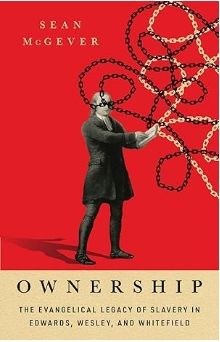
Ownership: The Evangelical Legacy Of Slavery In Edwards, Wesley, And Whitefield
Sean McGever
If we as Christians are to understand ourselves and our legacy more clearly, it must be done in sight of how God views each and everyone one of us. Christian history must be a God-first history, it cannot be an empirical or deductive history alone.
When I read Sean McGever’s Ownership: The Evangelical Legacy of Slavery in Edwards, Wesley, and Whitefield I had a narrative running in the back of my mind (which I have had for some time) about why it is that Christian history includes so much human activity that has resulted in so much misery and suffering. This got me thinking about Christian history as understood in the context of its theological underpinnings.
A common pattern I have noticed in Christian history is that influential Christians often step outside of scriptural teachings to justify various questionable practices and decisions they made. The doctrinal fallacy of 'in the name of' is frequently invoked to rationalize such practices. In my opinion, the legacy of slavery in 18th century colonial North America as explored in Sean McGever’s work supports this historical theme and underscores its core thesis. This where the enslavement of human beings by Christians sought justification by its practitioners.
From McGever’s book, I get the impression that Jonathan Edwards, John Wesley, and George Whitefield were people not overly concerned with worldly politics, ‘social justice’, or economic institutions (including slavery) that facilitated material concerns. McGever shows how during their time, matters of conscience were not resolved through the avenues of political and social policy in the same way that many people would expect today. Rather, McGever’s work shows how influential evangelical Christians in the colonies acted in worldly ways, yet still sought to religiously justify their questionable actions before God. Through scriptural rationalization, before and after the fact, acting ‘in the name of Christianity’ as a form of appeal to ‘greater good’, many 18th century ‘English Christians’, as McGever calls them, fell into a consistent 'in the name of Christianity' pattern of religious folly that is also found elsewhere throughout history. The book focuses on how key figures in 18th century colonial evangelical history regarded practice of enslavement, but also reveals how the same pattern of 'in the name of Christianity' doctrinal fallacy influenced the everyday practices of the average colonial evangelical family. McGever reveals how the drift away from scriptural authority sometimes happened erroneously but also, sometimes intentionally.
On matters of conscience, and in the context of slavery as a moral wrong, I think the three influential evangelical Christian leaders who are the focus of McGever’s discussion, were concerned more with what happens to all people when they leave this world over what happens to them within this world. Even with this common theme among them, interestingly, there appears to be great variability among how this heavenward outlook was held and expressed by John Wesley, George Whitefield, and Jonathan Edwards in the context of slavery.
While Whitefield and Edwards were both gifted with words (albeit in very different ways), and while the theology of Edwards remains influential and authoritative (even if it has been criticized for lacking grace), the way both Whitefield (the grind it out crowd-pleasing orator) and Edwards (the elite and gifted religious scholar) lived in the era of slave ownership, is marked by a very wide gap between what their spoken and written words profess contrasted by their individual attitudes toward slavery.
John Wesley’s experience coming face to face with the grimness of colonial slavery for the first time, I think caused a stir, very different from the effect that its practice had on both Whitefield and Edwards. Wesley came to develop deep concern for the well-being of slaves in consideration of the institution of slavery in the colonies (this likely did not exclude concern for their freedom from bondage in the soteriological sense either I would expect). Wesley utilized specific examples of the harms inflicted onto slaves that he witnessed in the colonies when he came to publish his anti-slavery literature.
From the book, it is clear that George Whitefield was a man of noticeable contradictions, and perhaps holding room inside to find deeper personal spiritual insight and growth. McGever presents Whitefield as a man who liked to speak to whichever social cause was top of mind for people, but would also be useful for himself at the same time.
McGever’s assessment shows that Whitefield was a man whose words and actions indeed had a wide gap between them. Despite being a gifted preacher, McGever gives the impression that Whitefield struggled to maintain steadfast character and to really hold firm internal convictions. In chapter six, McGever demonstrates Whitefield’s words vs. action discrepancy this way: following an incident known as the Stono Revolt, in which twenty white people were killed during this slave uprising, influential Whitefield published a scathing letter, outlining his deep concern for the harmful treatment of colonial slaves. Yet, several months following this, Whitefield travelled to London to advocate in parliament for the legalization of slavery in Georgia (which had not yet legalized slavery). In The Colonial Records of Georgia, among economic benefits to the colonies, Whitefield’s key rationale for the legalization of slavery in Georgia was, according to McGever “too hot for White people. He believed that only Black slaves were able to work in these conditions” (p. 90).
During this fervor of advocacy for the legalization of slavery in Georgia, Whitefield had built orphanage on a 500-acre plot of land in Bethesda, Georgia. However, due to an inability to hire laborers to work the planation on its grounds, the orphanage fell into deep financial trouble. At this time, Whitefield enlisted some of the orphans themselves after they had come of age to labor at the orphanage. This economic scramble convinced Whitefield that legalizing slavery in Georgia would provide the best prospect of economic survival for the orphanage (the orphanage was an endeavor which Whitefield was lukewarm to taking on, but for which he had taken responsibility). Eventually, British Parliament did legalize slavery in Georgia, and the benefit to Whitefield was relief from his financial problems with respect to the orphanage and its plantation, with the newfound ability to acquire slaves to work the plantation.
I thought this next part in McGever’s narration of Whitefield’s life gives the most insight into his mindset: Whitefield went to the Bible to find justification for purchasing slaves after his economic problems were improved. In line with the narrative historical that Christian figures perpetuate societal harms such as the institution of slavery, it was as though Whitefield had to rationalize to himself his purchase of slaves by consulting scripture as an 'in the name of' justification to himself. What I found encouraging however, was that something became unsettled within him upon his purchase of slaves. After consulting with scripture, Whitefield concluded that the “temporal concern” of being a slave would be outweighed by the opportunity his slaves would have to hear the news of the gospel (p. 92). As mentioned, building the plantation/orphanage was not Whitefield’s idea, but he took it on. John Wesley had written him a letter urging him to build it, urging Whitefield that the experience would help him more closely understand God’s will for him (p.80).
On Wesley’s suggestion that Whitefeld build the orphanage, McGever gives the impression that Wesley’s intention was to help brash Whitefield acquire greater personal humility. In chapter one, McGever discusses Whitefield’s gift of the gab and tendencies toward showboating in great detail (p. 23). In a brief snippet about John Wesley’s character (p. 17), McGever shows how Wesley had the great gift to “organize” people to action. From this, I inferred that Wesley well understood what Whitefield’s strengths and areas for spiritual development were. Wesley had written Whitefield a letter urging him to take on the orphanage, selling him on the idea of it an ambitious and novel undertaking in which he would come to have a better understanding of God. I think Wesley presented this kind of selling point to Whitefield because it would have appealed directly to his elevated sense of self.
For Jonathan Edwards, the gap between word and deed takes on a much different nature. Edwards was highly educated theologian where Whitefield was largely a self-taught preacher. Edwards was thoroughly versed in scripture, and grew up in a culturally high-profile ‘elite’ Puritan family. Edwards’ soteriology is notable for its grimness and harshness, bordering on merciless even. Edwards' theology is also well noted for presenting a dismal outlook for this world. Edwards' soteriology is deeply preoccupied with the sinful human condition under perfect God, and presents God's assurance of salvation for the next world one of scarcity where all are slave to sin no matter their station or religious habit. Edwards’ famous sermon “Sinners in the Hands of and Angry God” and well-known treatise: “Freedom of the Will”, both challenge the smugness of the Christian who would consider himself saved simply by going through the customary motions of baptism and public profession Christ as savior. Much of Edwards’ evangelical writing is focused on urging people to truly change their hearts to be aligned with God. That is, not just for their outward comportment to be changed, but also for true transformation to be made within them by the Holy Spirit.
As for Edwards' own outward actions, I think he was concerned for the redemption and salvation of all people from worldly bondage, both slaves and slaveholders alike. His very narrow and hardline view of redemption and salvation in the context of the sin held within all people was his primary concern. For this reason, I do not think he had very much interest in criticizing the pre-established institution of slavery, because in his eyes, it would have been a slavery ‘only’ of this world. Edwards’ indifference to the legal purchase and enslavement of people, as McGever points out, is reflected in Edwards rare discussions about the practice, even though he was a prolific writer and preacher. Edwards himself owned slaves and kept them as part of what was considered an orderly colonial household, demonstrating that enslavement was a normalized aspect of his worldview. Edwards was not known to be cruel with the slaves who worked in his home, but instead, McGever gives the impression that Edwards was largely indifferent to the practice of enslavement due to the fleeting nature of this human physical-world existence .
In the recount of Wesley’s first interactions with both slaves and slaveowners, and from Wesley’s first witness to the practice of slavery, it is notable that while both Edwards and Whitefield owned slaves, Wesley seems to have become unsettled in his conscience upon his first encounters with enslavement. Although Wesley did not immediately express a publicly negative opinion about the institution of slavery (I would not have expected him to have done so, given the slower pace of communication, upon witnessing enslavement first-hand, something different began to happen with Wesley, and similarly, the attitude toward slavery in the colonies at that time had started to shift away from a normalized view of the practice despite its institutional establishment historically the world over.
While this was not discussed explicitly in the book, it reminded me of an effect described by Scottish Philosopher David Hume (1711-1776) that happens when a kind of moral leap in mindset takes hold both in societal outlook and/or from within individual hearts. Hume termed this: a ‘moral leap’. What happens is people do not know why they think it, but something just strikes them as ‘wrong’ and then they go back and fill in the reasons why they believe something is wrong after their experience of the moral leap.
In these leaps, people don’t know why they feel something is morally wrong, but they feel it first, and then try to understand and explain why they feel that way. For the Christian leaders who are the focus of this book, plus many more people who lived during that time, it is notable that in the context of Hume’s contemporary philosophical observation, attitudes toward enslavement, despite its hand-in-hand history with the story of all humanity, was becoming less easy to justify during the 18th century and its practice was being called into question. In the 19th century, British Parliament abolished the practice, but by that time, the United States had become an independent nation.
In chapter four, McGever covers some of the gritty details of theological justification for slavery during the 18th century. McGever outlines biblical defenses of the practice that were commonly held, and his depiction reveals just how thin the distinction between biblical justification and psychological rationalization actually were.
In the colonies, a kind of ‘theology of slavery’ emerged (perhaps an awkward way to term how the practice was justified). McGever well articulates the theological underpinnings for slavery held by 18th century colonists. McGever argues that the 'theology of slavery' as typically held was held in common by most ‘English Christian’ colonialists, as he describes them. This included Puritans, Presbyterians, Congregationalists, and Baptists. Matthew Henry’s ‘Commentary on the Whole Bible’ and Richard Baxter’s ‘Christian Directory’ were two highly influential, but non-binding writings discussing how Christians ought to practice family and civic life, including how slaves ought to be treated within the household.
For 18th century English Christians living in the colonies, the justification for holding slaves found in the pages of Henry’s and Baxter’s works urged for treatment of slaves as part of the family, and with kindness. However, as Wesley discovered upon visiting the colonies, the reality of enslavement in practice severely ignored these guidelines, and often was instead one full of harm and malice inflicted onto the enslaved. The Henry and Baxter writings considered it the duty of slaveholders to evangelize those they enslaved because both authors held the opinion that all people deserved to receive spiritual freedom through hearing the gospel. For a slaveholder to deny the gospel to the enslaved person would have been considered a sinful practice based on Henry and Baxter's guidelines. Yet, in a difficult to justify theological contradiction, if conversion within an enslaved person occurred, it was generally not an instituted practice for slaveholders to free the converted slave from worldly bondage.
A stranger problem with the justification for slavery in the Christian colonies was where a drift from Bible teaching altogether arose. Justification among slaveholders to deny the gospel to their slaves was argued from the non-biblical teaching that McGever terms: polygenesis, whereby enslaved black people were denied the gospel with the rationale being their created origins were different from Adam's lineage. This view was based on a new evolutionary ‘scientific’ theory known as polygenesis, implying that it was not possible for black slaves to be saved in the Christian sense. This rationalization was the one that I found the most unusual. For colonists who took this view, the will to keep slaves (but I would expect with economic fears below the surface also) held greater sway beyond what biblical ‘justification’ was thought to provide. The polygenesis justification became entrenched for many slaveholders, even when it was pointed out to not be biblically defensible position to hold. Farther east from Europe, and on the shores of northern Africa, Christianity already had a long history by the 18th century. Ironically then, colonial slaveowners who held polygenesis justification to deny the gospel to those they enslaved, disregarded, and/or did not know what the skin tone of the early Christians would have been. McGever handles the contentious theological underpinnings of slavery in this chapter very well, citing primary resources as best as possible to speak the thornier aspects of this era in its own words.
What I liked very much from the outset of the book was that McGever keeps the question of ‘what would you have done if you lived during those times?’ at the front of the readers’ mind. Also, McGever frequently reminds the reader that the pace of travel and communication was much slower than it is today. I get the impression, based on how McGever describes John Wesley’s visit to Georgia and South Carolina that observant people in those days would have taken their strong feelings about things in a much slower way before drawing conclusions and making outward statements about established practices. With this in mind, I also get the impression that people who saw the wrongs of the time, took great time and care to form measured responses to seek to right the wrongs they observed in their era.
Although there was much brutality inflicted onto slaves (beyond being enslaved as a premise), the emerging ‘moral break’ with the practice of slavery, particularly as per John Wesley’s intake of the situation upon witnessing it for the first time, speaks to something that stirred within him in particular, as distinct from Edwards and Whitefield as fellow evangelical leaders discussed in the book. If Whitefield had any internal convictions about slavery, they would have been self-serving first, and I think Edwards, with his mind elsewhere, was indifferent to the established practice, simply accepting slavery as part of normalized life.
I thought that Sean McGever handles this sensitive topic with great care, while still remaining objective and with humility toward people and their life and times. One criticism I have is that McGever’s book leads all the way through with a colonialist-first viewpoint. This is so, even when he draws from sources critical of the practice. I would have like to have seen his book track down more examples from the enslaved person’s perspective looking outward, where it would have been possible. Nonetheless, there is a lot to think about in the pages of Sean McGever’s bold book.
-Matthew Kryzanowski
Review Of:
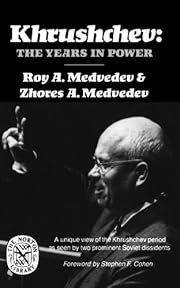
Khrushchev: The Years In Power
Roy Aleksandrovich Medvedev & Zhores A. Medvedev
A concise but densely packed work. Perhaps because of its translation from Russian it is easy for modern Westerners to get bogged down in unfamiliar terminology. The book is a political biography of the mid-20th century Soviet leader Nikita Khrushchev and his years in power (1953-1964). It is quite a read by twin brother intellectuals who lived under the Soviet regime. Khrushchev wrestled with the inherited legacy of Stalin's paranoia and the fallout from the mass terror state. The authors have written an objective and dispassionate examination of life in the Soviet Union under Khrushchev's leadership, despite their ideological dissent toward the regime.
Khrushchev embarked on a policy of 'De-Stalinization'. Contending with 2nd World War German POWs who had yet to be released, as well as an estimated staggering total of 13-15 of million Soviet citizens (at minimum) who were imprisoned in concentration camps for various "crimes". This became a 'moral' imperative and very much also quite an opportunity for Khrushchev and his wing-men to advance and bolster political support for themselves and the regime. It is asserted that during the Stalin years Khrushchev himself was not very much opposed to mass imprisonment as part of the state apparatus (as a minimal statement). As a way of saving political face, and risk not exposing the dubious claims to crimes these citizens were found "guilty" of committing under Soviet 'law', the process of releasing citizens from concentration camps was called "rehabilitation". The release was a minimal trickle during the first several years. The authors estimated that 7-8 million people were declared 'rehabilitated' and released in the 1950s, while 5-6 million people were "rehabilitated" posthumously. As in, they had died while incarcerated in work camps, but were somehow to regain something of their "dignity" and "freedom" as the Soviet State so inhumanely defined the process of 'rehabilitation', including posthumous "rehabilitation". For me, this was one of the most outrageous atrocities of the USSR. Not only the appalling mass round-up of citizens ('my what a lovely apartment you have'), but the audacity of authorities to 'save political face' by granting 'pardon' from whatever excuse or pretense these people were extricated from their lives and families for having been accused of and having been found 'guilty' of 'committing'. To me, that in itself is a grotesque form of indignity.
The book is also candid about Khrushchev's rashness toward action. The rush to deforest Kazakhstan for its rich soil, in the name of Soviet agricultural self-sufficiency is particularly notable. Embarrassingly for Khrushchev and Soviet leadership, during this period of the Cold War, there were several lean years of grain scarcity and risk of famine because of the recklessness in Kazakhstan. To avoid famine, the Soviets had to resort to receiving aid from the United States to help feed Soviet citizens. The idea of food-supply self-sufficiency in the Soviet Union failed disastrously in this regard.
Interestingly for me, several years ago, I had a debate on social media with a college professor who I would describe more as a Soviet apologist but identifies as a Soviet historian. He agreed that the deforestation of Kazakhstan had meant that food supply quotas had not been met, but denied that the Soviets had to appeal to the United States for assistance when those lean years occurred. Extraordinarily, he stopped engaging with me on the platform, yet continued to spout 20th century Soviet rhetoric and dogma as fact to all who would listen. Strangely, yet perhaps not so strangely for other reasons, he had quite a following of 'yes' people on that platform. This book reinforced for me the types of catastrophic problems that will arise when ideology is held in higher regard over people. Soviet history demonstrates how people will become blinded and inculcated into political systems of belief when such kinds of lies are perpetuated without checks and balances, or conversely, they will become harmed or distressed when they can see through ideological fear-dogma and seek to avoid participation.
For people coming of age in the 21st century, Khrushchev: The Years in Power offers a powerful way to understand the harms of coercive ideology. Do not expect a 'pleasant' or 'light' read, but certainly expect a worthwhile introduction specifically to problems with mid-20th century communism and to problems with collective ideologies more broadly. Reading and reflecting on this book will benefit people who are quick to advocate for, and to endorse redistribution economics and top-down politics over growth economics and the benefits of citizen self-autonomy. In the context of technological advancement and innovation, surveillance society has become normalized in the 21st century. As a consequence, the presumption of innocence is becoming tremendously weakened as customary practice and cultural mindset in the West. For this reason additionally, this book offers a worthwhile learning opportunity. Once again: 'my, what a lovely apartment you have'.
- Matthew Kryzanowski
Review Of:
The Displacement Dilemma: Navigating the Survival of Human Expertise in an AI-Driven World
Nigel Cannings

The Displacement Dilemma: Navigating the Survival of Human Expertise in an AI-Driven World is a terrific primer on the state of AI as it relates to professional-level work. The book was published in Fall 2024, and although the problems with AI the book highlights have already become entrenched and embedded more deeply within professional work, the Displacement Dilemma is still worth reading.
Mr. Cannings rightly begins with the acknowledgement that AI has already (as of September 2024) been developed far enough such that many routine digital tasks that people undertake have already been integrated with AI technology to the point where people are often unaware they are using it. For example, the author references phone photography technology and its ability to directly auto-optimize photos while people are in the very process of taking a photo, even while the photographer remains unaware.
Mr. Cannings' focus is directly on analyzing the capacity for AI to complete professional-level tasks that were once solely the domain of educated specialists. For example, the author cites how lawyers-in-training who spend years articling in order to hone their craft of understanding the nuances of the justice system, and how the attainment of this skill-set quite easily can be surpassed by the ability of AI programs to analyze legal data. AI can be trained to draw conclusions similar to a team of trained lawyers with access to databases that it can quickly and easily scan and analyze. Similarly, AI appears to be very much capable of interpreting medical tests with accuracy at parity with or even with greater ability to spot potential health problems than medical professionals are able to do.
Cannings goes on to show how these problems present many thorny legal grey areas to be navigated as AI becomes increasingly relied on to perform such tasks. This has also created and will very much continue to create an existential crisis for professionals in various fields.
While I am grateful for Mr. Cannings' business and industry insights from within the field of AI technology, I felt Mr. Cannings presents an overly optimistic view of the emerging AI world, while his remedy for legal and ethical problems to not be as optimistic sounding as he might have been trying to persuade. While the human touch, the 'bedside manner' so to speak, the ability to empathize, or to relate to clients/patients/customers/ etc. can be considered an intangible human asset that AI will have difficulty competing with, I believe in 10-20 years' time (or perhaps even sooner), it is plausible that the AI 'genie out of the bottle' may render such skills irrelevant anyway.
To this point, as a person born in the last quarter of the 20th century, I consider myself to be an 'immigrant' to web-based technology. In contrast, there are many full-grown adults today who have never known life without the internet, and the distinction between what happens online and in real-life is already quite blurred. My concern is that adults coming of age 10-20 years from now will never have known a world without AI integrated technology into their life. For this reason, I think that future professional people will likely be indifferent to, or worse, oblivious to just how integrated AI will be in their activities and lives. Going forward, I think this will represent a potential loss of personal agency that may very well slip away quietly from the human experience (professional-level or otherwise). In me, the book raised deeper questions about what the ethical and moral implications AI will have on the nature of human interactions and what impact they will have on the human experience more broadly. While provoking, I do not think Mr. Cannings' book goes far enough to address the loss of a human-first focus that is emerging even where he is focused specifically within the business/professional context.
While I felt the industry focus of Mr. Cannings' book was very insightful, the book has left me with lingering questions, but with a more nuanced understanding of ethical concerns that I had before reading it. Although Mr. Cannings offers an optimistic picture of the future of AI use, I still have many questions and much skepticism that ethical concerns with AI will even be possible to resolve, or will be possible to be well-resolved. As a result of reading this book, I have gained some further clarity on the topic of ethical AI, and I will say that is a positive motivation for others to read this book, and for others to apply a similar lens to apply while reading it.
Again, while the inside business/industry viewpoint of AI development was outstanding, I felt that Mr. Cannings' remedy for ethical problems arising from AI advancements fell short.
That tightening legislation and development of legal frameworks in various regions where such endeavors are seen as important (and they most certainly are), the problem is that web-based technology can travel across legal jurisdictions with ease. Instantaneous transmission of unethical research results for example, between regions where legal frameworks are looser or even non-existent to regions with tighter legal frameworks could present opportunities for AI usage to be abused in order to cause problems or to inflict harm. I am thinking about AI autonomous submarines carrying nuclear warheads as an example, or for potentially unethical research conducted on people to be proliferated with ease.
If you read Displacement Dilemma as a jumping off point, it is an excellent early contribution to the study of AI and the pains that will continue to arise during the societal transformation underway coinciding with its invention.
- Matthew Kryzanowski
Review Of:
A Cleansing Flame: Bachelard Interpreted Volume 2
Frank Prem

I am glad to have had the opportunity to digest this work, and by extension, to learn more about French Scientist and Philosopher Gaston Bachelard from whom Mr. Prem has drawn inspiration to create his collection of poetry: Bachelard Interpreted. As of February 2026, Prem's poetry collection derived from Bachelard's work has six volumes published.
Having been newly exposed to the work of Frank Prem, admittedly, I found the first section initially to be a bit cumbersome and seemingly lacking in any kind of anchor. I felt as though I was reading something that described the properties of fire poetically, but lacked a way to hold the theme of 'Fire' in place. However, upon reflection, I came to the conclusion that such is the disorienting nature of fire itself, particularly when it is looked at up close. The more one tries to contain it (in print or otherwise), the more fire escapes being restricted inside of definable parameters. As I read further, I found this theme reoccurred as a key feature of the poems themselves, and also as the way the aspects of Fire were presented themselves. I have capitalized 'fire' because I believe this reflects the idea found throughout A Cleansing Flame that fire is more than an element alone, but that it also represents a life-like entity of its own. By the time I reached the poem 'light and lies', I could see that Mr. Prem's skillful ability to create imagery of Fire and Flame very much became apparent. 'a philosophy of fragile times', 'two times', and the poems tied to the theme of solitude in the first section all very much resonated with me. The first section comes to fulfillment as an exposition on Fire that is an element external to, yet relentlessly influential upon peoples' psyche.
The second section: 'Psychoanalysis of Fire' is an intriguing exploration of peoples' relationship with Fire as well. Even through its very title, this section ascribes to Fire a mind of its own. 'the alchemist's fire', 'fizz', and 'the physics of the unconscious' all spoke to me of man's wish to harness fire and yet, the will of Fire itself seeks to remain untamed.
Finally, I will say that in 'Fragments from a Poetics of Fire' which encompasses the third section of this volume, I was really grabbed by the poem 'medium' in particular, because it turns the notion of the act of writing poetry (but really any kind of writing) on its head. The flow of ideas, it is proposed in 'medium', is channeled from the ideas themselves through the poet, onto the page, and not the other way around. This is quite a relatable experience for people who compose music or who create visual arts. With very powerful imagery, surprisingly (or perhaps not) this particular poem references 'Water' as its element and not 'Fire'.
Mr. Prem successfully continues to bring the work of under-known Gaston Bachelard to the English-speaking world, through his poetry collection: Bachelard Interpreted, and along with it, Mr. Bachelard's contention that the study of science is not a purely objective endeavor as is a commonly held, drawing attention to what is perhaps an erroneous point of view, particularly in the West. While a scientist might very likely, and as best as possible, undertake a project in as dispassionate a way as possible, the personal psychology of the scientist still very much remains an influential force on his/her approach to their own scientific study and practice. Frank Prem demonstrates Bachelard's philosophy of science in an inventive and accessible way. I highly recommend this poetry series.
- Matthew Kryzanowski
Idea Factory Press Book Reviews Are Copyrighted Content
Copyright ©️Idea Factory Press, 2026